English learning log

English learning log

... DO YOU THINK ...

2021. augusztus 04. - polly graph

Who invented the telephone? + DO YOU THINK = WHO do you think invented the telephone?

What do you think was invented by bell?

How much do you think a kilo of onions costs?

When do you think the first call was made ...?


----------------------

Mit gondolsz, hol van Zaire?

Mit gondolsz miért sír az a gyerek?

Mit gondolsz mennyit fizettem ezért a cipőért?

Mit gondolsz ki fog a szomszédba költözni?

Mit gondolsz hogy vezet Péter?


LESSON OF AUG 04

HOMEWORK:

https://englishexam.blog.hu/2021/06/30/zero_waste_living_is_the_future_match_the_questions_with_their_answers

KEY:

https://englishexam.blog.hu/2021/07/01/match_interview_questions_and_answers_joost_bakker

1F 2B 3H 4G 5E 6A 7C 8D

Additional exercise:

https://englishexam.blog.hu/2021/07/09/vocabulary_from_zero_waste_reading

https://englishexam.blog.hu/2020/05/13/when_do_you_think_this_photo_was_taken

At the beginning of the video we were shown a black and white portrait and we were asked a question.

Random people were asked about the man in the photo.

Only one woman was able to guess when the photo was taken.

The women were astonished when the correct answer was revealed.

The 23-year-old lady, who introduces herself, comes from Brazil.

A digital colorist restores and colorizes black and white photographs.

The man whose portrait we saw at the beginning of the video wanted to kill an American president.

Lewis Powell is probably still alive.

If you colorize black and white photos you make them look more real.

The colorist changes many things in the photos.


The last portrait shows a girl who lost everything.


How many languages are there in the world?
How many languages DO YOU THINK there are in the world?
----------------------------------------------------------------------------------------
LISTENING:
---------------------------------------------
INVENTIONS THAT CHANGED THE WORLD:
--------------------------------------------------------
BRITISH AND AMERICAN WORDS:
BRITISH AND AMERICAN PHRASES
WOULD YOU RATHER:


https://www.hias.org/sites/default/files/conversation_starters-would_you_rather_questions.pdf

https://jimmyesl.com/would-you-rather-questions/


My best friend

We met at the elementary school when we were 12 years old. We didn't go to the same school but we played volleyball together. It was a good practice and we enjoyed it very much.

I think she is very helpful. I remember that in high school we studied together for history because she is very good at this subject  and she helped me a lot. She is always very happy, she is always in a good mood and she makes me laugh. No matter how tired we are, we can always laugh at everything. She is always ready to do something interesting if I call her at 9 o'clock in the evening. (113 szó)


JOB APPLICATION LETTER

WORDS TO USE IN THE GAPS: additional, apply, believe, candidate, experience, have, references, service, strengths, strong, via

John Donaldson
8 Sue Circle
Smithtown, CA 08067
909-555-5555
john.donaldson@emailexample.com

August 15, 2020

George Gilhooley
Times Union
87 Delaware Road
Hatfield, CA 08065

Dear Mr. Gilhooley,

I am writing to ......... (1) for the programmer position advertised in the Times Union. As requested, I enclose a completed job application, my certification, my resume, and three .......... (2).

The role is very appealing to me, and I .......... (3) that my strong technical experience and education make me a highly competitive ........... (4) for this position. My key ........... (5) that would support my success in this position include:

  • I ........... (6) successfully designed, developed, and supported live-use applications.
  • I strive continually for excellence.
  • I provide exceptional contributions to customer ........... (7) for all customers.

With a BS degree in Computer Programming, I have a comprehensive understanding of the full lifecycle for software development projects. I also have ...........(8) in learning and applying new technologies as appropriate. Please see my resume for ........... (9) information on my experience.

I can be reached anytime ........... (10) email at john.donaldson@emailexample.com or by cell phone, 909-555-5555.

WORDS TO USE IN THE GAPS: additional, apply, believe, candidate, experience, have, references, service, strengths, strong, via

(https://www.thebalancecareers.com/job-application-letter-sample-2062548)

VOCABULARY FROM 'ZERO WASTE' READING

advocate, beverage, biodiversity, decentralize, endeavor, nourishment,  ox , plough, self-sustaining, sustainable, tame,   zero waste
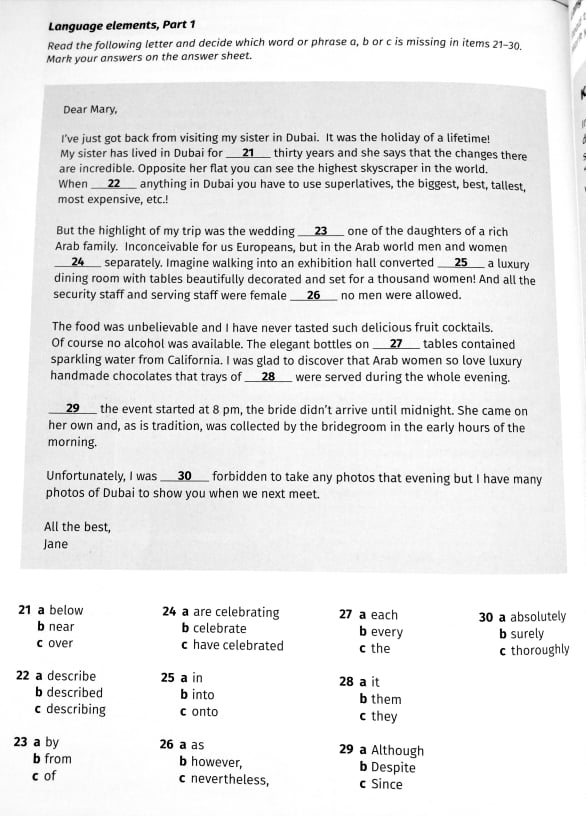
Mother's milk is the best .......... (1)  for a baby. 

The manuscript for the musical was a collaborative ......... (2)  that included two writers, a composer, and a lyricist.  

He became a strong .......... (3) for parliamentary reform.

.......... (4) development implies a long-term perspective.

All these organizations push forth to make our world clean and producing ........... (5).

The Pueblo Indians live in adobe houses, are quiet and usually .......... (6), and have been converted to the forms of Christianity.

She brought the vegetables in an .......... (7) cart.

If we .......... (8), the provinces will have more autonomy.

The newcomers can pose a threat to ........... (9) by altering ecosystems. 

Farmers occasionally .......... (10)  up old Indian relics.

Lunch includes dessert, and soup or a .......... (11) .

The government needs to do something to ........... (12)  inflation.

advocate, beverage, biodiversity, decentralize, endeavor, nourishment,  ox , plough, self-sustaining, sustainable, tame,   zero waste

Greenhouse by Joost Bakker

Read the interview with Australian designer, floral artist, eco-warrior and champion of no-waste living Joost Bakker, who wants to turn our cities and suburbs into sustainable urban farms. Find the right question for each answer. You will find the possible questions (A-H) at the beginning and at the end of the reading.

Questions to use in the gaps:

A: How are you hoping Future Food System will inspire all of us to live a little better?

B: You moved to Australia from the Netherlands when you were nine. How did your childhood shape your interests and inspire this obsession with sustainability?

C: Two top chefs, Matt Stone and Jo Barrett, are living in the house and eating and serving only what is grown inside. What part does food and nourishment play in this zero-waste system?

D: What's your best advice for travellers who want to live a greener life while on the road?

E: Future Food System is located in in the heart of Melbourne and many of your previous restaurants were based here too. Why do you think Australia is the right place for your endeavours?

F: You've been described as "one of sustainability's most provocative advocates". Why is it important to be so forthright on the topic, and why is this especially important right now?

G: You've long campaigned for sustainable and bio-favourable design and living. What are some of the best examples of sustainable living that you've seen around the world?

H: What are some of the most important things we need to be doing to shift both our health and the health of the planet?

1: ...   2: ...   3: ...   4: ...  5: ...  6: ...  7: ...  8: ...


Q: .............................................................  (1)

My whole life story revolves around waste and zero waste, and I have a real belief that human beings need to adopt what the rest of the planet already uses, which is a zero-waste approach. We're the only species that doesn't do this.

But I've never been somebody that's been vocal. I don't go out and do talks and say, "this is what we should do". Instead, I'm a big believer in physical projects. For me, it's always been about showing rather than telling. I think a living, breathing example is the best way to educate people, and that's why Silo, the world's first zero-waste cafe that I opened in Melbourne in 2012, was so successful.

Visitors can tour Future Food System or book in for dinner to learn more about the self-sustaining, zero-waste house (Credit: Dean Bradley)

Visitors can tour Future Food System or book in for dinner to learn more about the self-sustaining, zero-waste house (Credit: Dean Bradley)

I remember a journalist saying to me in 2008 that zero waste is impossible. But that's not true – so much has changed in 13 years. There are so many zero-waste solutions out there now, from using waste to make packaging to domestic bio-digesters that turn organic waste into highly valuable fertiliser.

I genuinely believe that we can live sustainably and it's not that radical. People are now seeing from our Instagram page that urban food can be really exciting. And on an individual level, we're all starting to reduce our waste. My goal is that by 2030 the idea of urban food is mainstream and something that we're all doing in some way, shape or form. I'm just an early adopter. As my friend [Australian chef] Neil Perry once told me, "You're 10 years ahead of your time."

Q: ............................................................. (2)

The Netherlands had a big influence on me. The Dutch are leaders in sustainability. They're living on reclaimed land that needs a lot of maintenance; they're constantly pumping water.

The Dutch need to protect their land, which means they're not going to be cutting trees down. Recycling was always a big part of growing up there and sustainable packaging was normal. Their past of battling water means that they have a mentality of sustainability and survival that goes back hundreds of years. I'm a big believer in multigenerational knowledge; that you pass on certain traits through the generations.

My father was a tulip farmer in the Netherlands. I have strong memories of the tulip farm at harvest time when flocks of birds would follow the ploughs to get at the newly exposed worms – there were so many worms that the soil turned pink. I saw this again when I travelled in Nepal as a 19-year-old; an ox was pulling a plough and the soil was wriggling with worms.

Award-winning chefs Matt Stone and Jo Barrett are living solely off the food and resources produced by Future Food System (Credit: Dean Bradley)

Award-winning chefs Matt Stone and Jo Barrett are living solely off the food and resources produced by Future Food System (Credit: Dean Bradley)

My dad used to say that lots of worms equals healthy, happy people, and I remember thinking these were the happiest people I had ever met. And that's when I started to realise that soil impacts mental wellbeing. It was his influence that led me to this conclusion and started me on my journey of turning waste into something valuable.

Q: ............................................................. (3)

My goal is for us to decentralise our food system. Our food system is most destructive thing that humans do – it causes deforestation, land clearing, desertification and loss of biodiversity. Synthetic fertiliser has allowed there to be eight billion of us today, but that has come with a nutritional cost. The nutrient density is not there in our food anymore, and much of the world is now overfed and undernourished. We can't go back to the way we farmed 100 years ago as our population has grown so much since then, and we can't just keep importing food.

And that's why I think that urban food systems have a huge potential to grow most of our food. They have the potential to include millions of people and the opportunity to rewild rural land that's no longer being used for farming.

The nutrient density is not there in our food anymore, and much of the world is now overfed and undernourished.

They can also deal with waste at the source and put that back into our food system as fertiliser. For me, it's all about the soil: healthy soil means healthy food and healthy people.

Q: ........................................................... (4)

I think living sustainably is an international movement. It's happening all over the world, and it's mainly being driven by younger people. We should look to places like Montreal, which has a tax exemption on rooftop gardens, as does Singapore. New York is also an exciting place with so many rooftop farms and gardens.

In the future I expect to see more cities around the world using greening to cool buildings and growing plants indoors. By 2030, I imagine that buildings in Melbourne's CBD will be covered in plants and households will have some form of aquaponics system with their own fish or urban growing system.

Future Food System upcycles waste to power the house and grow nutrient-dense produce (Credit: Dean Bradley)

Future Food System upcycles waste to power the house and grow nutrient-dense produce (Credit: Dean Bradley)

Q: ............................................................. (5)

My most vivid memory is arriving in Melbourne. I was nine and we drove from the airport through the Sherbrooke Forest, which is about 300 million years old. In Holland, all the trees have been planted by someone. Instead, I was in sheer wilderness. Australia is so difficult to tame, and there's so few of us compared to Holland, where 17 million people live in a place half the size of Tasmania. I immediately loved how wild Australia was and how clean the air was.

In addition, what's so beautiful and different about Australia is that we're a country of migrants. That means you've got this biodiversity of ideas here that you don't have in the Netherlands. The Dutch are very tolerant, but that's different. They don't have the outside influences that we do here. That gives us the ability to move much quicker – for example, Australians are incredibly fast to take up new technology. Sweden, Denmark and Holland are very good at publicising what they do as being sustainable, but Australia is actually doing incredible things when it comes to sustainability. And Melbourne in particular has a highly creative community that embraces these ideas.

Q: ............................................................. (6)

I've tried to keep things simple. I've got one rule, if you can't recycle it or if it's not biodegradable, don't use it. We have a biodigester downstairs, which is essentially a big black bladder filled with the same microflora that's in a cow's stomach, that ferments whatever is in it. You put organic waste in it and for every kilo of organic waste you put in it, you get incredible fertiliser plus an hour of cooking gas.

We keep crickets in an old esky (cooler) as a food source. We have a mushroom wall that uses the humidity from the shower and condensation from the hot water service; and the floor is made from recycled concrete and recycled wine bottles. I turned 44-gallon drums into wicking beds as it's a low-tech and cheap solution.

Through the tours of Future Food System, we want to highlight and celebrate foods that people can grow on their balconies and in their houses, even if it just inspires someone to start off planting parsley. It's about having a connection to your food and to the soil.

Located in the centre of Melbourne, Future Food System is just 87sq m in size (Credit: Earl Carter)

Located in the centre of Melbourne, Future Food System is just 87sq m in size (Credit: Earl Carter)

Q: ............................................................. (7)

Good food comes from rich soil, and soil is literally the foundation of the house. There's 35 tonnes of soil in barrels holding this building in place, and I made the soil completely from waste, using things like rock dust, scallop shells, oyster shells, composted organic waste and worm castings.

Good food comes from rich soil, and soil is literally the foundation of the house

Matt and Jo use the produce grown in the soil in our three-hour multi-course dining and beverage experiences, which are open for the public to book. Each sitting has 14 guests who eat in our open kitchen/dining area. We have yabbies, mussels and crickets for protein, and we get honey for sweetness from our bees. We use sorghum as a grain as it's native to Australia and doesn't take much space.

We also use traditional ingredients like the tiger nut, which is an important food source all over the world as it's very high in fat and nutrients. It's also herbicide-resistant and it grows everywhere. We dry the tiger nuts and grind them into flour for cakes and bread, and make milk and ice cream from them. It's probably the only plant-based milk that comes close to the nutrient density of cow's milk, and it's much more sustainable.

Matt and Jo are vital to the project because I believe that if the food they serve is appealing, people will be inspired. It brings a modern slant to the topic of sustainability. People don't want to go backwards; they want to go forwards. They don't want sustainability to be seen as a compromise, which is why I called it the Future Food System because I think that's desirable, achievable and exciting.

Mushrooms grown on a mushroom wall are served up to the public as part of the dining experience (Credit: Earl Carter)

Mushrooms grown on a mushroom wall are served up to the public as part of the dining experience (Credit: Earl Carter)

Q: ............................................................. (8)

I think that tourism is a great way to make people care about the planet. I'm obsessed with the Amazon because I visited it 20 years ago. Travelling is a way to make people fall in love with the world and become more thoughtful in their use of resources.

I believe that travellers should immerse themselves in local life and eat what the locals do, as that's the most exciting thing about being somewhere new. What's the point of eating a hamburger in Paris? And what message are you sending by wanting to eat a hamburger in Paris? Think local wherever you are, and always think about how to travel better. I love that there's a huge push in battery-powered planes and sustainable ways to get to remote locations.

There's also a global trend to be more sustainable; hotels and resorts are looking to do better, and travellers can fuel that demand. If you go to a place and demand that they don't use plastic water bottles or other single use plastics, it'll quickly force change. I'm confident that if we keep moving in this direction, the damage we've caused to our planet can be reversed quickly.

--


Questions to use in the gaps:

A: How are you hoping Future Food System will inspire all of us to live a little better?

B: You moved to Australia from the Netherlands when you were nine. How did your childhood shape your interests and inspire this obsession with sustainability?

C: Two top chefs, Matt Stone and Jo Barrett, are living in the house and eating and serving only what is grown inside. What part does food and nourishment play in this zero-waste system?

D: What's your best advice for travellers who want to live a greener life while on the road?

E: Future Food System is located in in the heart of Melbourne and many of your previous restaurants were based here too. Why do you think Australia is the right place for your endeavours?

F: You've been described as "one of sustainability's most provocative advocates". Why is it important to be so forthright on the topic, and why is this especially important right now?

G: You've long campaigned for sustainable and bio-favourable design and living. What are some of the best examples of sustainable living that you've seen around the world?

H: What are some of the most important things we need to be doing to shift both our health and the health of the planet?

FILL IN THE GAPS - using vocabulary from the crossword (words from Speak Simply pages 202-205)

https://learningapps.org/watch?v=psem6025v21

Words to use: barely, broaden,  joy, means, misleading, obtain, recover, respond, via, vulnerable

1. Old people are particularly  .......... to the coronavirus disease.

2. How do you ......... to nasty comments?

3. She flew to Los Angeles .......... Chicago.

4. Television is an effective .......... of communication.

5. The article was ........... and the newspaper had to apologise.

6. He could .......... read and write.

7. He went to the mountains to .......... his health.

8. You should .......... your experience by travelling more.

9. Where can I .......... her latest book?

10. I gave out a cry of ........... on seeing my mother.

Words to usebarely, broaden,  joy, means, misleading, obtain, recover, respond, via, vulnerable


Filling Gaps | Lead Today


süti beállítások módosítása